The Real Cost of Late Payments for US Freelancers
According to research from the Freelancers Union, the average US freelancer loses $6,000 per year to late payments — not because clients refuse to pay, but because there's no system in place to ensure invoices get prioritized.
A late payment isn't just a cash flow problem. Every dollar that sits with a client instead of in your account is a dollar you can't reinvest in tools, courses, or business development. And the time you spend chasing those payments — the follow-up emails, the awkward messages — adds up to hours every month that should be spent on billable work.
The good news: late payments are almost entirely preventable with the right systems. Here are 7 strategies that work.
Strategy 1: Always Collect a Deposit Upfront
This single habit eliminates the majority of non-payment risk. Require 25–50% of the project value before any work begins. Clients who refuse an upfront deposit are a warning sign — serious clients understand that deposits protect both parties.
Industry benchmark: Freelancers who require deposits experience 73% fewer non-payment disputes than those who invoice entirely at project completion.
Strategy 2: Use a 3-Stage Automated Reminder Sequence
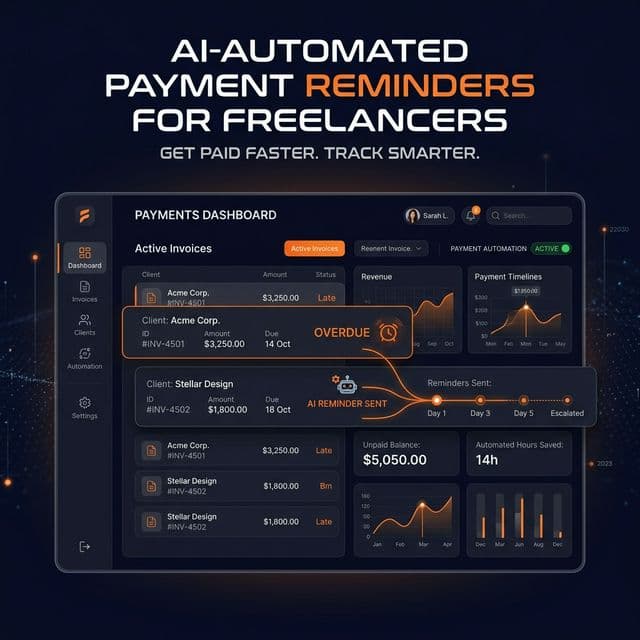
Manual follow-ups are inconsistent and emotionally draining. The solution is a pre-scheduled, automated sequence:
- 3 days before due: Friendly heads-up. Positive tone. Reduces surprise.
- On the due date: Professional reminder. Direct but not confrontational.
- 7 days overdue: Firm notice. Mentions late fee if applicable per your contract.
Tools like DepositPulse inside FreelancerPulse automate this entire sequence. You set it up once and it runs indefinitely — collecting payments while you focus on billable work.
Strategy 3: Clarify Payment Terms in Your Contract
Your contract should explicitly state: the payment schedule, due dates, accepted payment methods, and the late fee (typically 1.5% per month) that applies to overdue invoices. Vague contracts produce vague payment behavior.
Including a late fee clause — even if you never enforce it — statistically reduces days-to-payment by an average of 8 days.
Strategy 4: Invoice Immediately After Each Milestone
Never batch invoices. Invoice the moment a deliverable is accepted. Delay between delivery and invoicing correlates directly with delayed payment — clients' psychological "freshness" of the value you delivered fades quickly.
Strategy 5: Accept Multiple Payment Methods
Friction kills payment speed. If your only option is bank transfer, some clients will delay simply because the process is inconvenient. Accepting PayPal, credit card, ACH, and wire transfer removes every excuse a client could have for not paying immediately.
Strategy 6: Track Every Invoice in a Centralized System
Spreadsheets work until they don't. The moment you have more than 5 active clients, a centralized dashboard becomes essential. You need to see — at a glance — which invoices are outstanding, which are overdue, and which have been paid.
FreelancerPulse's DepositPulse tool provides exactly this: a real-time overview of every outstanding deposit with status indicators and automated action triggers.
Strategy 7: Send a "Thank You" Email When Payment Arrives
This seems small but matters enormously for long-term client relationships. A quick, personal "thanks for the prompt payment" email reinforces positive behavior. Clients who receive this are measurably faster payers on future invoices.
The Bottom Line
Late payments are a systems problem, not a client problem. Build the right system — automated reminders, clear contracts, upfront deposits — and you'll see your average days-to-payment drop significantly within 60 days.
Start with FreelancerPulse's DepositPulse for free — no credit card required.